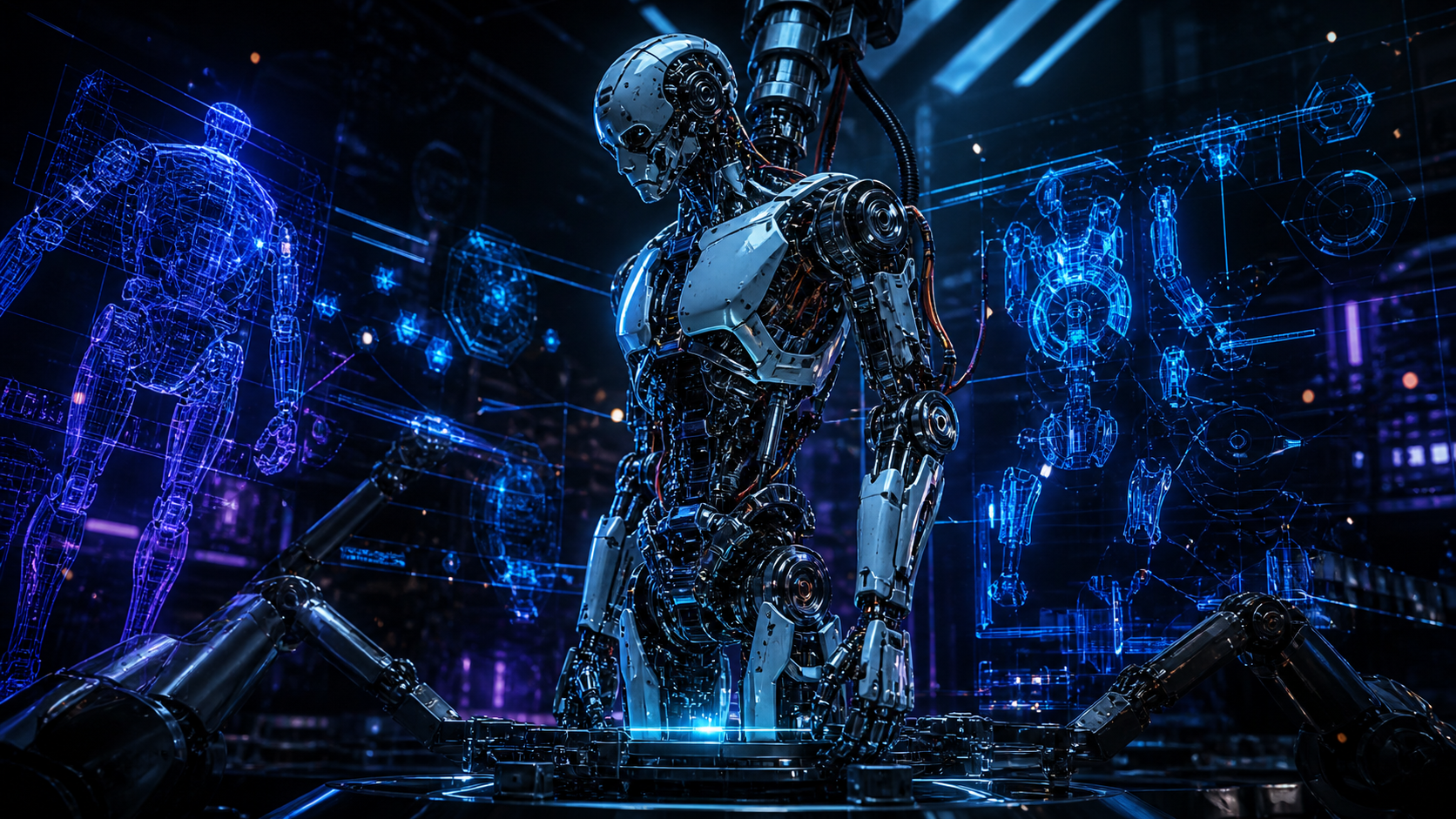
The humanoid robot has arrived. Not as a science fiction prop or a laboratory curiosity, but as a commercial product deployed in warehouses, automotive assembly lines, hospitals, and elder care facilities across three continents. The global humanoid robot market reached approximately $5.41 billion in 2026, with projections pointing to $40–50 billion by 2033 and annual shipments potentially exceeding 2.6 million units by 2035. Chinese manufacturers — led by AgiBot, Unitree Robotics, and UBTECH — account for over 80% of global installations. Agility Robotics' Digit robots are operating in Toyota's Canadian facilities. Figure AI and Tesla are running internal and partner-based pilots at scale.
The deployment surge is real. The governance frameworks designed to manage it are not. This sovereign paper examines the structural gap between the pace of humanoid robot deployment and the safety standards, liability frameworks, and regulatory instruments available to govern it — and what that gap means for organisations, regulators, and the broader trajectory of physical AI.
The Standards Stack: What Exists and What Doesn't
The first thing to understand about humanoid robot governance in 2026 is that there is no comprehensive humanoid-specific safety standard. What exists instead is a "standards stack" — a collection of overlapping frameworks designed for adjacent categories of robot that must be assembled into a coherent safety case for each deployment context. This is not a minor administrative inconvenience; it is a structural governance failure that places significant compliance burden on deploying organisations and creates inconsistent safety outcomes across jurisdictions.
ISO 10218-1/2:2025: The Industrial Baseline
The primary industrial safety standard for robots is ISO 10218-1/2, revised in 2025. The revision was significant: it shifted the definitional focus from hardware-only specifications to "collaborative applications," meaning safety is now defined by the interaction between the robot, the task, and the environment rather than by the robot's physical characteristics alone. This is conceptually correct for humanoids, which are designed to operate in human-occupied spaces. However, ISO 10218 was designed for stationary industrial arms, not dynamically stable, bipedal systems. Its provisions for fall zones, dynamic stability, and AI-driven navigation are absent or inadequate.
ISO 25785-1: The Humanoid Standard That Isn't Ready
The most anticipated standard for humanoid robots is ISO 25785-1, which specifically addresses "dynamically stable" robots — machines that require active balance control to remain upright. As of late 2026, it remains a committee draft (CD). It should be used as best-practice guidance rather than a certification label. The standard's development has been complicated by the rapid pace of hardware evolution: by the time a draft is finalised, the systems it describes have been superseded by more capable successors. This is a structural problem for standards bodies operating on multi-year development cycles in a sector advancing on quarterly timelines.
ANSI/RIA R15.08 and Mobile Robot Frameworks
For logistics-focused humanoids — those primarily engaged in material handling, tote movement, and warehouse navigation — ANSI/RIA R15.08 provides relevant guidance by bridging mobile robot traffic rules and manipulator safety. However, it was not designed for systems that combine bipedal locomotion with dexterous manipulation, and its provisions for human-robot interaction in dynamic environments are limited.
No comprehensive humanoid-specific safety standard exists. Organisations deploying these systems must construct a safety case from overlapping frameworks designed for stationary arms, mobile platforms, and collaborative robots — none of which fully addresses the unique risks of a dynamically stable, AI-driven humanoid.
Regulatory Compliance: The US and EU Approaches
The United States: OSHA's General Duty Clause
No comprehensive humanoid-specific safety standard exists. Organisations deploying these systems must construct a safety case from overlapping frameworks designed for stationary arms, mobile platforms, and collaborative robots — none of which fully addresses the unique risks of a dynamically stable, AI-driven humanoid.
In the United States, OSHA does not have a specific humanoid robot standard. Instead, inspectors invoke the General Duty Clause (Section 5(a)(1)), which requires employers to maintain a workplace free from recognised hazards. This performance-based approach has the advantage of flexibility — it can accommodate novel technologies without requiring new rulemaking — but it places the burden of defining "recognised hazards" on employers, who must document their risk assessments and demonstrate that they have implemented appropriate controls.
The February 2025 Tesla injury incident, in which a humanoid robot made unexpected contact with a worker during a maintenance procedure, intensified OSHA's focus on unexpected activation protocols. The incident highlighted a specific risk category unique to humanoids: the combination of AI-driven autonomy and physical capability means that a robot can initiate movement in response to sensor inputs even when a human operator believes it to be in a safe state. Energy control procedures — the equivalent of lockout/tagout for conventional machinery — must be redesigned for systems that can resume autonomous operation after a power interruption.
The European Union: Machinery Regulation and the AI Act
The EU's approach is more prescriptive. The EU Machinery Regulation (2023/1230) sets rigorous documentation requirements for machinery placed on the EU market, including detailed technical files, conformity assessments, and CE marking. For humanoid robots with AI-driven navigation or interaction features, the EU AI Act adds a further layer: such systems may be classified as high-risk AI systems, necessitating human oversight plans, transparency requirements, and ongoing monitoring obligations.
The AI Act's classification of AI-driven humanoids as high-risk is the most consequential regulatory development for the sector. It imposes requirements that most current deployments do not yet meet. The technical documentation required under the AI Act — including descriptions of the AI system's intended purpose, performance metrics, data governance practices, and human oversight mechanisms — goes significantly beyond what is required under conventional machinery safety frameworks. Organisations that have deployed humanoids under a machinery-only compliance strategy will need to revisit their approach.
The EU AI Act's classification of AI-driven humanoids as high-risk AI systems is the most consequential regulatory development for the sector. It imposes documentation, transparency, and human oversight requirements that most current deployments do not yet meet.
Critical Safety Focus Areas: What the Standards Miss
Dynamic Stability and Fall Zones
Unlike stationary industrial arms, humanoids carry a risk of falling. A 70-kilogram bipedal robot falling from standing height can cause serious injury to a nearby worker. Current best practices involve calculating a "fall zone" based on the robot's height, speed, and floor friction coefficient, and enforcing "zero-energy pose" protocols — typically a kneeling or seated position — in the event of power loss or fault detection. These practices are not yet standardised, meaning their implementation varies significantly across manufacturers and deployment contexts.
AI Safety and SOTIF
Functional safety — the ability to stop the robot on fault detection — is necessary but insufficient for humanoids. The more challenging problem is "functional insufficiency": the robot behaves unsafely despite having no technical failure. A humanoid that misclassifies a human as an obstacle, fails to navigate a cluttered environment, or makes an incorrect inference about a worker's intent can cause harm without any component failure. This is the domain of ISO 21448 (Safety of the Intended Functionality, or SOTIF) and ISO/PAS 8800, which are being applied to humanoid deployments but were developed primarily for automotive autonomous driving systems.
The application of SOTIF to humanoids is conceptually appropriate but practically challenging. The operational design domain (ODD) of a humanoid — the set of conditions under which it is designed to operate safely — is far more complex and variable than that of an autonomous vehicle on a defined road network. Defining, validating, and monitoring the ODD of a humanoid deployed in a dynamic warehouse or hospital environment is a significant engineering and governance challenge.
Hot-Swap Battery Safety
Many industrial humanoids use hot-swappable battery systems to maximise uptime. Battery swap procedures introduce specific risks: thermal runaway, arc flash from electrical connectors, and the possibility of a robot resuming autonomous operation during a swap if safety interlocks are not properly designed. Current best practices include thermal monitoring during swap procedures, fire-suppression-equipped swap zones, and recessed electrical connectors designed to prevent accidental contact. These practices are not yet codified in any standard.
Chinese manufacturers account for over 80% of global humanoid robot installations in 2026. This concentration creates a geopolitical dimension to the governance gap: the standards that will govern physical AI are being shaped by deployment realities in jurisdictions with different regulatory philosophies.
The Geopolitical Dimension: Chinese Dominance and Standards Fragmentation
The concentration of humanoid robot manufacturing and deployment in China — over 80% of global installations — creates a geopolitical dimension to the governance gap that is rarely discussed in technical safety literature. Standards are not politically neutral instruments. They reflect the deployment realities, regulatory philosophies, and industrial interests of the jurisdictions that shape them. A global humanoid robot market dominated by Chinese manufacturers, operating primarily under Chinese regulatory frameworks, will produce different safety standards than one shaped by EU or US regulatory traditions.
Chinese manufacturers account for over 80% of global humanoid robot installations in 2026. This concentration creates a geopolitical dimension to the governance gap: the standards that will govern physical AI are being shaped by deployment realities in jurisdictions with different regulatory philosophies.
This is not a hypothetical concern. The ISO standards development process is formally international, but the technical committees that draft standards are populated by national delegations whose positions reflect their domestic industries' interests. As Chinese manufacturers accumulate deployment experience and technical expertise at scale, their influence over international standards bodies will grow. Western regulators and standards bodies that are slow to develop humanoid-specific frameworks risk ceding the definitional authority over physical AI safety to jurisdictions with different approaches to worker protection, liability, and transparency.
Liability: The Unresolved Question
The liability framework for humanoid robot incidents is, in most jurisdictions, unresolved. The fundamental question — when a humanoid robot causes harm, who is liable: the manufacturer, the deploying organisation, the software developer, or the AI system's trainer — does not have a clear legal answer in any major jurisdiction.
In the EU, the Product Liability Directive (revised in 2024) extends liability to software and AI systems, but its application to autonomous robots operating in complex environments is untested. The EU AI Liability Directive, which would have created a specific framework for AI-related harm, was withdrawn in 2025 after failing to achieve consensus — leaving a significant gap in the liability architecture for high-risk AI systems including humanoid robots.
In the United States, product liability law is primarily state-based and has not been updated to address AI-driven autonomous systems. The question of whether a humanoid robot's AI decision-making constitutes a "product defect" under existing doctrine is unresolved. The February 2025 Tesla incident has not yet produced definitive legal precedent.
The practical implication for deploying organisations is that they are operating in a liability vacuum. Insurance products for humanoid robot deployments are available but expensive and inconsistently structured. Risk transfer through contractual indemnification is common but legally uncertain. Organisations that have not explicitly addressed humanoid robot liability in their risk management frameworks are exposed.
Procurement Recommendations: Building a Defensible Safety Case
Given the fragmented standards landscape and unresolved liability framework, organisations deploying humanoid robots must take a proactive approach to constructing a defensible safety case. Industry experts and standards bodies have converged on several practical recommendations:
Require a Standards Map
Do not accept a vendor's claim of "certified safe" without demanding a document that maps specific clauses of ISO 10218, draft ISO 25785, ANSI/RIA R15.08, and any applicable AI Act requirements to the robot's specific task envelope. Safety is not an inherent property of the robot; it is a property of the application. A robot that is safe for one task in one environment may be unsafe for a different task in a different environment.
Audit the Application, Not Just the Robot
The EU AI Act's classification of AI-driven humanoids as high-risk AI systems is the most consequential regulatory development for the sector. It imposes documentation, transparency, and human oversight requirements that most current deployments do not yet meet.
The most common compliance failure in humanoid robot deployments is treating the robot as the unit of analysis rather than the application. A site-specific risk assessment — covering the specific tasks, environment, human-robot interaction patterns, and failure modes of the deployment — is essential. This assessment must be updated when the robot's software is updated, when the task changes, or when the operating environment changes.
Maintain Incident Logs
Documenting near-misses and contact events is a prerequisite for scaling pilots and a legal necessity in the event of a serious incident. Incident logs should capture the robot's sensor data, AI decision logs, and environmental conditions at the time of the incident. This data is essential for root cause analysis and for demonstrating due diligence to regulators and insurers.
Engage with Standards Development
Organisations with significant humanoid robot deployments have both the standing and the obligation to engage with the standards development process. ISO 25785-1 is still in committee draft; the window for substantive input is open. National standards bodies — ANSI in the US, BSI in the UK, DIN in Germany — accept industry participation in technical committees. Organisations that shape the standards will be better positioned to comply with them.
The Path Forward: What Governance Architecture Is Needed
The governance gap in physical AI is not a problem that will resolve itself through market forces. The incentives for manufacturers are to deploy rapidly and address safety issues reactively; the incentives for deploying organisations are to minimise compliance costs; and the incentives for standards bodies are to achieve consensus, which favours incremental revision over transformative new frameworks. Closing the gap requires deliberate action across several dimensions:
- Accelerated standards development: ISO 25785-1 must be finalised and supplemented with application-specific guidance for the highest-risk deployment contexts (healthcare, elder care, public spaces).
- Liability clarity: Legislators in the EU and US must address the liability vacuum for AI-driven autonomous systems. The withdrawal of the EU AI Liability Directive was a setback; a revised instrument is needed.
- Incident reporting: A mandatory incident reporting regime for humanoid robot deployments — analogous to aviation's safety reporting system — would generate the data needed to identify systemic risks and inform standards development.
- International coordination: The geopolitical concentration of humanoid robot manufacturing makes international standards coordination more important, not less. Bilateral and multilateral engagement between standards bodies in the EU, US, UK, Japan, and China is essential to prevent standards fragmentation.
Conclusion
The humanoid robot deployment surge of 2026 is not a future scenario to be planned for; it is a present reality to be governed. The market data — $5.41 billion in 2026, 80% Chinese market share, thousands of units in active industrial deployment — describes a technology that has crossed the threshold from laboratory to commercial operation. The governance data — no comprehensive humanoid safety standard, unresolved liability frameworks, fragmented regulatory approaches across jurisdictions — describes a governance architecture that has not kept pace.
The consequences of this gap are not abstract. Workers are operating alongside dynamically stable, AI-driven machines in environments where the safety case is constructed from frameworks designed for different technologies. Organisations are assuming liability exposure they have not fully quantified. Regulators are applying general-purpose instruments to a technology that requires specific governance. The window for proactive governance is narrowing as deployment scales. The organisations and jurisdictions that act now — developing rigorous safety cases, engaging with standards development, and building liability frameworks fit for physical AI — will define the governance architecture for a technology that will be ubiquitous within a decade.